We use cookies to make your experience better. To comply with the new e-Privacy directive, we need to ask for your consent to set the cookies. Learn more.

June 05, 2026
The Complete Guide to Creatine Monohydrate
Creatine monohydrate is the most researched supplement in the history of sports nutrition. Thousands of peer-reviewed studies, decades of real-world use in elite sport, and consistent results across every level of performance from Olympic athletes to everyday gym-goers. And yet there is still considerable confusion about what it actually is, how it works, and whether it is right for you.
This guide covers everything you need to know. We have been formulating creatine monohydrate since 1978, and in that time, we have seen a great deal of nonsense written about it. This is not that. This is a clear, honest, evidence-based guide to one of the most effective and well-understood supplements you can take.
What Is Creatine Monohydrate?
Creatine is a naturally occurring compound made in the body primarily in the liver, kidneys and pancreas from three amino acids: arginine, glycine and methionine. It is also found in small amounts in meat and fish. Your body stores creatine predominantly in the muscles, where it plays a direct role in the production of energy.
Creatine monohydrate is the supplemental form of creatine, creatine bound to a water molecule, and it is this form that has been studied most extensively. When you take creatine monohydrate as a supplement, you are increasing the total creatine stored in your muscles beyond what diet and natural synthesis alone can provide.
The result is a measurable improvement in power output, strength, and the capacity for high-intensity effort. It is not a stimulant. It does not mask pain or reduce fatigue in the way a pre-workout might. What it does is give your muscles more of the fuel they need to contract forcefully, repeatedly and quickly.
How Creatine Monohydrate Works: The ATP Connection
To understand what creatine monohydrate does, you need to understand how your muscles produce energy. The primary energy currency of every cell in your body is adenosine triphosphate ATP. When your muscles contract, ATP is broken down into adenosine diphosphate (ADP), releasing energy in the process.
The problem is that your muscles can only store a small amount of ATP directly. During high-intensity exercise, such as sprinting and lifting heavy, explosive movements, that supply runs out within seconds. What happens next determines how well your body performs under load.
This is where creatine monohydrate earns its reputation. Creatine is stored in the muscles as phosphocreatine (PCr). When ATP runs low, phosphocreatine donates a phosphate group to ADP, regenerating ATP rapidly. The more phosphocreatine available in the muscle, the faster and more completely ATP can be restored, and the longer you can sustain peak effort.
Supplementing with creatine monohydrate increases the total phosphocreatine stores in your muscles, research suggests, by up to 20 to 40 per cent in individuals who are not already creatine-saturated. More phosphocreatine means more ATP regenerated more quickly. That translates directly into greater power output, more reps, faster recovery between sets, and improved performance in any activity that demands short, explosive bursts of energy.
The Benefits of Creatine Monohydrate: What the Evidence Shows
Strength and Power Output
The most consistent finding in creatine research is an improvement in maximal strength and power. A 2003 meta-analysis in the Journal of Strength and Conditioning Research reviewed 22 studies and found that creatine supplementation produced a significant increase in maximal strength typically in the region of 8 per cent over placebo. For trained athletes already close to their natural ceiling, this is meaningful.
Lean Muscle Mass
Creatine monohydrate supports muscle growth in two ways. First, by enabling more training volume more reps, more sets, heavier weight it creates a greater stimulus for adaptation. Second, creatine draws water into muscle cells, increasing cell volume and creating an environment that supports protein synthesis. Studies consistently show greater lean mass gains in creatine-supplemented groups compared to placebo.
Cognitive Function
This is perhaps the most underappreciated benefit of creatine monohydrate. Your brain, like your muscles, runs on ATP. Research has found that creatine supplementation can improve performance on tasks requiring short-term memory, working memory and mental processing speed particularly under conditions of sleep deprivation or mental fatigue. This is an area of growing research interest.
Older Adults and Healthy Ageing
Creatine monohydrate has well-documented benefits for older adults. Research shows that supplementation helps maintain muscle mass and strength in ageing populations, supports bone mineral density, and may reduce the risk of falls. Several studies have found positive effects on cognitive function in older adults as well. It is one of the most compelling cases for supplementation beyond the athletic context.
Recovery
By restoring phosphocreatine stores more rapidly, creatine monohydrate helps the muscles recover more effectively between sets and between sessions. Some research also suggests it may reduce markers of muscle damage and inflammation following intense training.
Who Should Take Creatine Monohydrate?
The honest answer is: almost anyone who exercises regularly. The evidence is strong enough and the safety profile robust enough that creatine monohydrate is one of the few supplements that warrants a broadly positive recommendation.
It is most clearly beneficial for: strength and power athletes (powerlifters, weightlifters, sprinters, field sport athletes); bodybuilders and those pursuing lean muscle development; recreational gym-goers looking to improve training performance; older adults seeking to maintain strength and muscle mass; individuals with physically demanding jobs or active lifestyles; and anyone looking to support cognitive performance under pressure.
Vegetarians and vegans tend to have lower baseline creatine levels due to the absence of dietary meat and fish, and often see particularly pronounced responses to supplementation.
How to Take Creatine Monohydrate
Dosage
The standard effective dose of creatine monohydrate is 3 to 5 grams per day. This is the dose supported by the majority of research and endorsed by bodies such as the International Society of Sports Nutrition.
Loading Phase: Is It Necessary?
A loading protocol 20 grams per day split across four doses for five to seven days will saturate the muscles more quickly and produce noticeable effects within a week. However, loading is not necessary. Taking 3 to 5 grams daily will reach the same endpoint of muscle saturation within three to four weeks. If you are not competing imminently and simply want the long-term benefits, there is no particular advantage to loading.
Timing
Timing matters less than consistency. Some research suggests a modest benefit to taking creatine monohydrate close to training either immediately before or immediately after but the effect is small compared to the benefit of simply taking it daily. Pick a time you will remember and stick to it.
What to Take It With
Creatine monohydrate mixes well with water, juice or a protein shake. It has no meaningful flavour at recommended doses. You can mix creatine with protein powder, many people do and there is no drawback to this. Carbohydrates and protein may slightly improve uptake by stimulating insulin, but this is not a critical consideration.
Is Creatine Monohydrate Safe?
Creatine monohydrate has one of the most extensive safety records in all of sports nutrition research. Studies looking at long-term use up to five years of daily supplementation have found no adverse effects on kidney or liver function in healthy individuals. The persistent myth that creatine damages the kidneys is not supported by the evidence and has been consistently refuted.
The only commonly reported side effect is weight gain in the first week of supplementation, which reflects water retention in the muscle rather than fat gain. This typically resolves as the body adjusts.
That said, if you have pre-existing kidney disease or other medical conditions, it is sensible to consult your GP before starting any new supplement.
Why Pharmaceutical Grade Matters
Not all creatine monohydrate is the same. The supplement industry has a poor track record of quality control, with third-party testing regularly finding products that are underdosed, contaminated, or simply not what the label claims.
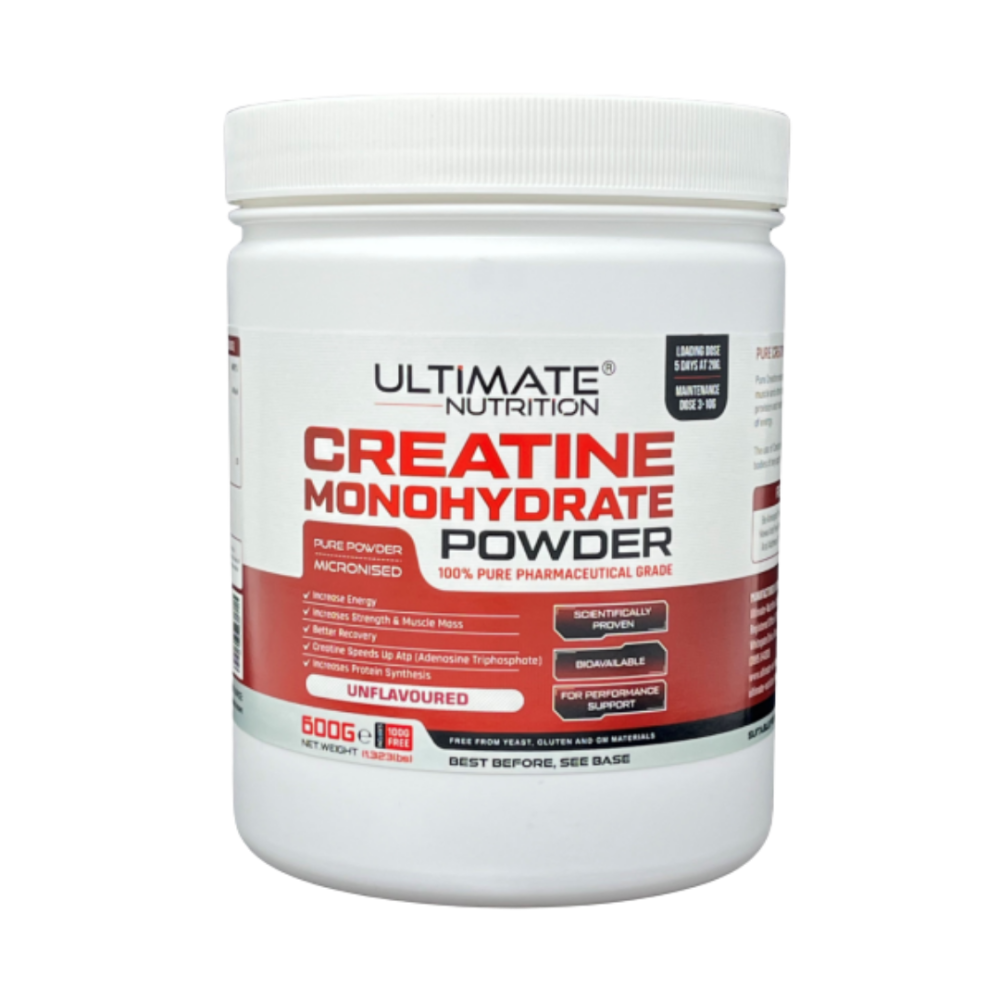
Ultimate Nutrition's creatine monohydrate is manufactured to pharmaceutical grade in England the same quality standards applied to licensed medicines. That means independent testing, verified purity, and consistent potency in every batch. Since 1978, this has been our standard. It is not a marketing claim; it is a manufacturing commitment.
Creatine Monohydrate vs Other Forms
The market is flooded with alternative forms of creatine creatine ethyl ester, buffered creatine (Kre-Alkalyn), creatine HCL, and others. Each is marketed with claims of superior absorption or reduced side effects. The evidence does not support most of these claims. Creatine monohydrate remains the most extensively studied form, with the strongest and most consistent body of evidence behind it. It is also the most cost-effective. There is no compelling scientific reason to choose a more expensive proprietary form over a high-quality creatine monohydrate.



Recent Posts