We use cookies to make your experience better. To comply with the new e-Privacy directive, we need to ask for your consent to set the cookies. Learn more.

June 21, 2026
How Does Creatine Work? The Science Explained Simply
What does creatine monohydrate do, exactly? That question has a very specific, well-understood answer, one that does not require a biochemistry degree to grasp. Here it is, laid out clearly.
Start With Energy
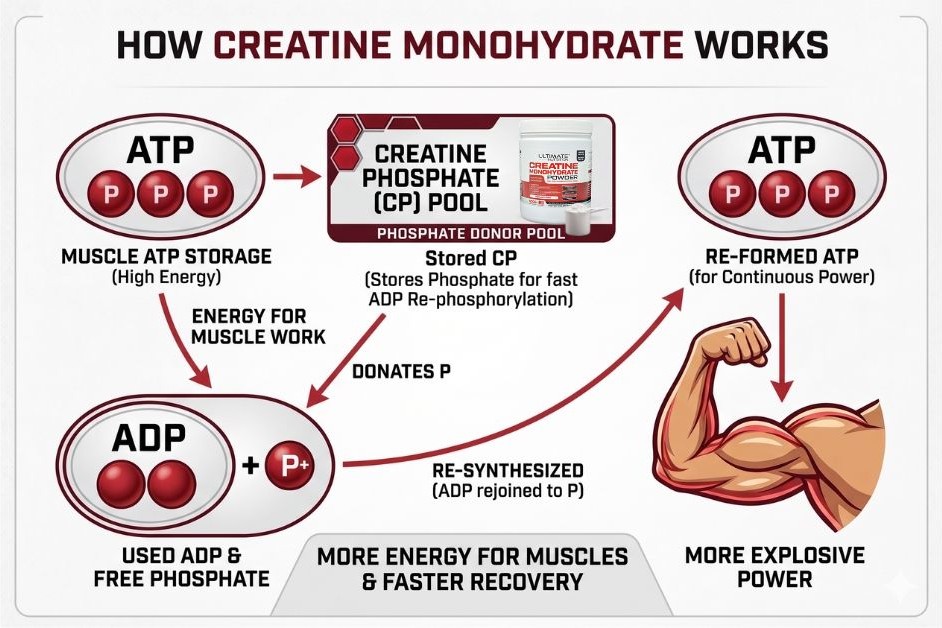
Every movement your body makes whether it is blinking or deadlifting twice your bodyweight requires energy. The universal energy currency in your body is a molecule called ATP: adenosine triphosphate. When a muscle fibre contracts, ATP is broken down into ADP (adenosine diphosphate), releasing energy in the process.
The problem is that your muscles can only store a very limited amount of ATP directly enough for roughly one to three seconds of maximal effort. That is useful for a single explosive movement, but not for a set of squats or a 200-metre sprint.
Where Creatine Comes In
This is what creatine monohydrate does: it replenishes your muscle's ATP supply, rapidly and repeatedly. Here is how.
Creatine in the muscle exists primarily as phosphocreatine (PCr). When ATP runs out during intense exercise, phosphocreatine donates its phosphate group to ADP, converting it back into ATP. This reaction happens almost instantaneously far faster than the other energy systems (the glycolytic system and the aerobic system) can produce ATP. It is your muscles' emergency rapid-refuel mechanism.
How does creatine work in practical terms? By increasing the total pool of phosphocreatine in the muscle, supplementing with creatine monohydrate means more ATP can be regenerated during and between bursts of intense effort. More ATP available = more work done = better performance
What Does Creatine Monohydrate Do to Performance?
The effects are most pronounced in activities that depend on the phosphocreatine energy system high-intensity, short-duration efforts with rest periods in between. Think: weightlifting, sprinting, interval training, throwing events, team sports involving repeated explosive efforts.
What creatine monohydrate does when used as a pre-workout or post-workout supplement: it increases peak power output, allows more reps at a given weight, reduces the drop-off in performance across successive sets, and shortens the time needed to restore phosphocreatine between efforts. The cumulative effect over weeks and months of training is significantly greater lean muscle development and strength gains.
Does Creatine Work for Aerobic Exercise?
The phosphocreatine system is primarily relevant to anaerobic exercise activities that do not rely on oxygen for energy production. For steady-state endurance activities like long-distance running or cycling at moderate intensity, creatine monohydrate has less direct impact on performance. That said, research has found benefits in sprint-finish capacity, high-intensity intervals within endurance training, and recovery between training sessions.
What About Creatine and the Brain?
Creatine is not just stored in muscle. The brain also stores and uses creatine for ATP production. Research has found that creatine monohydrate supplementation can improve performance on cognitive tasks requiring short-term memory and mental processing particularly under conditions of sleep deprivation or mental fatigue. This is an area of active and expanding research. What creatine monohydrate does for brain energy is essentially the same thing it does for muscle energy: it provides a faster route to ATP restoration.
Why Monohydrate Specifically?
Creatine monohydrate benefits are so well-documented because creatine monohydrate is the form that has been studied in virtually every landmark piece of creatine research. Alternative forms exist creatine HCL, buffered creatine, creatine ethyl ester but none have a body of evidence comparable to monohydrate, and independent testing has often found them inferior in actual creatine delivery. Monohydrate remains the reference standard.

Recent Posts