We use cookies to make your experience better. To comply with the new e-Privacy directive, we need to ask for your consent to set the cookies. Learn more.

August 21, 2026
Tribulus Terrestris: Benefits, Uses and What the Science Says
Tribulus Terrestris is one of the most discussed natural ingredients in sports nutrition, and one of the most misrepresented. It has attracted both devoted advocates and categorical sceptics, often based on a misunderstanding of the ingredient, the research, or (most commonly) the quality of products involved.
This guide covers everything you actually need to know about Tribulus Terrestris: what it is, where it comes from, how it works in the body, what the science genuinely shows, how to use it, and, critically, why product quality determines whether it works at all.
What Is Tribulus Terrestris?
Tribulus Terrestris is a flowering plant in the family Zygophyllaceae. It is native to warm temperate and tropical regions across southern Europe, Asia, Africa and Australia, notably tolerant of poor soils and desert climates, which speaks to the hardiness that has made it so widely available across ancient civilisations.
The plant has been used medicinally for over 5,000 years. In Ayurvedic medicine, the traditional Indian system of health, it is classified as a Rasayana: a rejuvenating tonic associated with vitality, strength, and sexual health. Traditional Chinese medicine has used Tribulus similarly for centuries, specifically for kidney and liver support, as well as reproductive health.
It was not until the 1970s that Tribulus gained significant attention in the West. Bulgarian strength athletes competing at the international level were reportedly using Tribulus-based preparations, which prompted a clinical investigation by Bulgarian researchers into its hormonal effects. That research established the mechanism by which Tribulus Terrestris is now understood to work.
The Active Compounds in Tribulus Terrestris
The beneficial effects of Tribulus Terrestris are attributed primarily to its steroidal saponin content, specifically a group of compounds including protodioscin, protogracillin, and related saponins. These are the active constituents, and their concentration in any given product determines its potency.
This is why extract standardisation matters so profoundly. A Tribulus Terrestris supplement standardised to 20% saponins and one standardised to 98% saponins are not comparable products, even at identical weights. The difference is not incremental: it is the difference between a meaningful dose of active compounds and a trace.
Other compounds present in Tribulus include alkaloids, flavonoids, and phytosterols, which may contribute to its broader health effects.
How Does Tribulus Terrestris Work?
The primary mechanism by which Tribulus Terrestris supports testosterone is indirect. Rather than providing testosterone or testosterone precursors directly, Tribulus stimulates the production of luteinizing hormone (LH) from the pituitary gland. LH is the hormonal signal that instructs the Leydig cells in the testes to produce testosterone.
This mechanism was documented in the Bulgarian clinical research from the 1970s and has been supported by subsequent studies. It is important to understand: Tribulus does not add testosterone; it stimulates the body's own production system. This is why it is classified as a natural testosterone booster rather than an exogenous hormone.
The practical implication is that the effect is most pronounced in men whose LH signalling has become less efficient, typically as part of the natural hormonal changes associated with ageing from the mid-thirties onwards. In younger men with robust LH and testosterone function, the effect is more modest.
Tribulus Terrestris: What the Science Actually Shows
Testosterone Support
Multiple studies have examined Tribulus Terrestris for its effect on testosterone levels. The most consistent findings are in older men with declining testosterone, where well-standardised extracts have been associated with improvements in LH levels and, consequently, testosterone. Studies using low-purity extracts have produced less consistent results, supporting the argument that extract quality is the critical variable.
Sexual Health and Libido
Tribulus has a long-standing traditional use for sexual health across multiple cultures. Clinical studies specifically examining libido and sexual function have generally reported positive outcomes, particularly in populations where testosterone decline is a factor. Arthur Fairhurst, in correspondence with thousands of customers over four decades of running Ultimate Nutrition, consistently noted that Tribulus, particularly in combination with Testo-Power, produced meaningful improvements in libido and sexual confidence in men who were experiencing testosterone-related decline.
Athletic Performance
Tribulus entered Western sports nutrition through the bodybuilding and strength sports communities in the 1980s and 1990s. Claims that it dramatically increases muscle mass in healthy young athletes have not been consistently borne out in research. However, its role in supporting testosterone levels in older, training athletes is better supported, and for men over 40 using it as part of a comprehensive strength training and supplementation protocol, the evidence is more favourable.
Menopausal Symptoms in Women
Tribulus is not exclusively a men's supplement. Research has examined its effects on oestrogen levels in perimenopausal and menopausal women, where Tribulus may support oestrogen production via the same LH-mediated mechanism (LH stimulates oestrogen in women as well as testosterone in men). Some studies have reported a reduction in menopausal symptoms, including hot flushes. Women considering Tribulus should note the advisory regarding potential hair growth at higher doses as directed.
Tribulus Terrestris and Horny Goat Weed: Why the Combination Matters
Tribulus Terrestris works well alone. It works better alongside Horny Goat Weed (Epimedium).
Tribulus operates on the LH-testosterone production axis. Horny Goat Weed, via its active compound icariin, works on the downstream response, supporting the sensitivity and function of testosterone-dependent tissues. The combination addresses both the hormonal production stimulus and the tissue-level response, producing a more comprehensive effect than either ingredient alone.
This is why Ultimate Nutrition specifically developed a combined Tribulus Terrestris and Horny Goat Weed formulation, rather than offering them only as separate products.
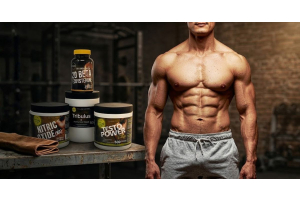
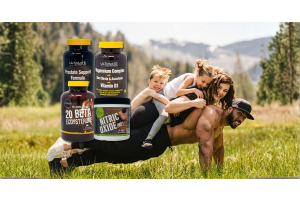
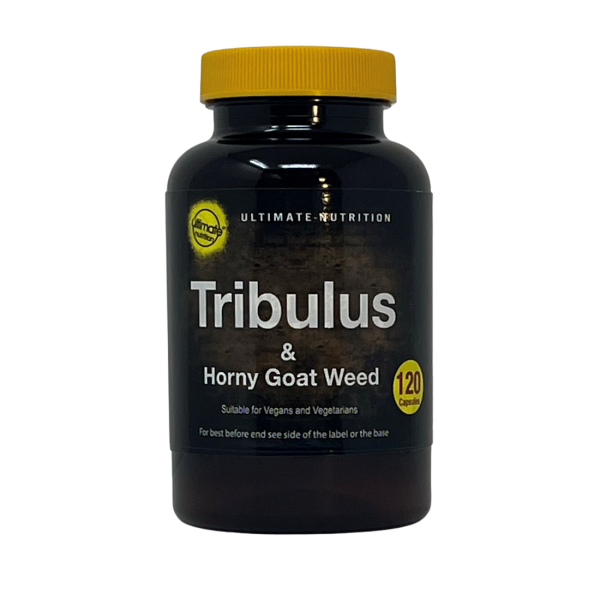
Ultimate Nutrition's 98% Tribulus Terrestris + Horny Goat Weed contains 510mg of 98% pure Tribulus extract per capsule, combined with 250mg Horny Goat Weed, plus Magnesium Oxide and Zinc Gluconate. Available as a 120-capsule pack or as part of the twin pack with Testo-Power 500 capsules. Made in England.
How to Use Tribulus Terrestris: Dosing and Timing
For the 98% Tribulus Terrestris + Horny Goat Weed capsules:
- Training days: 2 capsules 30 minutes before training, 1 capsule immediately after
- Non-training days: 3 capsules at any time during the day
- For a higher dose protocol requiring 3g per day, 4 capsules delivers this amount
Consistency is more important than timing precision. Daily supplementation over eight to twelve weeks is the appropriate time frame to assess results. Tribulus is not a stimulant; it works with your hormonal systems over time, not acutely.
What to Look for When Buying Tribulus in the UK
Given the variability in Tribulus Terrestris product quality, these are the specifications to check:
- Extract standardisation: look for 95% saponins minimum; 98% is the gold standard
- Dose per serving: 400–750mg of standardised extract is the research-supported range
- Transparent labelling: exact amounts per ingredient, no proprietary blends
- UK manufacturing: products made in Britain are subject to domestic regulatory standards
- No unnecessary fillers: a clean formulation with minimal excipients
Tribulus terrestris tablets and capsules vary enormously in quality. The price difference between a reputable 98% extract product and a budget supplement often reflects a fundamental difference in active content, not just margin.
Is Tribulus Terrestris Safe?
Tribulus is generally well-tolerated when used at recommended doses. It has been in use for thousands of years and has a strong safety profile. The notable advisory is for women: some women have reported increased hair growth (chin and chest) while taking Tribulus, which ceased upon discontinuation. This is consistent with the herb's testosterone-supporting mechanism.
As with any supplement, people taking prescription medications, particularly hormonal medications, should consult their GP before use.
Ultimate Nutrition has been formulating natural sports and health supplements since 1978 from Lancashire, England. Our 98% Tribulus Terrestris + Horny Goat Weed is made to the highest quality standards, no inferior substitutes, no fillers, no compromise.

Recent Posts